

What if Christians were treated the same way religious non-Christians are really treated here? In particularby those cynical stage performers – overly religious politicians and devout law-and-order types?
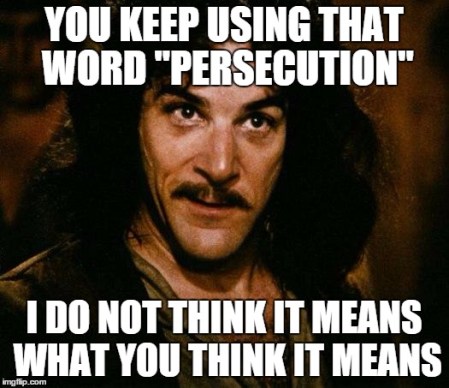
To wit:
Christians would be racially profiled at public places and transportation hubs.
Christians wouldn’t be allowed to build churches wherever they pleased.
Christians wouldn’t be allowed to wear their traditional garb without mocking and angry looks.
Christians wouldn’t be allowed to say the word “Jesus” without triggering alarm bells at the NSA.
Christians wouldn’t be allowed to go to church without having their property vandalized, and even being physically attacked.
Christians would be the villain in every action thriller.
Christians wouldn’t be able to run for office without having bigots accuse them of being in league with terrorists. – Marcos Moulitsas
Religious right leaders and their followers often claim that they are being persecuted in the United States. They should watch their words carefully. Not only are their claims offensive but the truth is most do not know the first thing about persecution.
What are some of the first things these blowhards don’t know?
In some countries, people can be imprisoned, beaten, or even killed because of what they believe.
Certain religious groups are illegal and denied the right to meet.
This is real persecution.
Not the sort of silliness that passes for civic patriotism in the Home of the Brave and Land of the Free. Being offended because a clerk in a discount store said “Happy Holidays” instead of “Merry Christmas” is truly deserving of mockery. Only the most confused minds would equate the two.
Religious “persecution” is something else entirely:
it is the natural pushback that occurs when any one sectarian group goes too far in trying to control the lives of others. When religious posersdemand that people who don’t even subscribe to their beliefs follow their rigid theology we do not witness social piety. We witness public hypocrisy.
Why, then, is there so much complaining from the religious right? The whining has to do with what we are not: Our nation is not the theocracy that many in the religious right would prefer.
When plenty of Americans resist our refusal to roll over and submit to them is a childish knee-jerk resorting to perceived persecution.
Case in point:
As the national discussion shifted to marriage equality, indications were that public sentiment was shifting. In the face of this, religious right groups could do little but start to spin wild tales of persecution.
Much of this was only so much carping, barely worthy of a response. Religious conservatives know full well that houses of worship in America can’t be forced to give admission or provide services to anyone. Churches have an absolute right to determine their own membership and the qualifications for earning it. Some houses of worship have an open-door policy and more or less welcome everyone. Others are stricter.
Yet the rhetoric continues to escalate. Why? How about shifts of cultural opinion. Conservative views on LGBTQ issues will become antiquated and, eventually, socially unacceptable.
It is not the job of the government to protect religious organizations from backlash against those organizations attitudes and policies regarding who is “righteous” and who ain’t.
Business owners who say their religious beliefs preclude them from offering business services to those deemed unworthy of respect believe a falsehood. Well, when a business functions fully licensed by government to serve the public there does not seem to be a clause in there that allows selective discrimination.
Are these business folks really being persecuted? These are retail establishments, not houses of worship. Generally speaking, public-accommodation laws in the United States prohibit retail stores and establishments that offer services from discriminating on the basis of race, color, religion, or national origin. These protections are found in the Civil Rights Act of 1964 and were intended, in part, to address issues such as hotels and restaurants that refused to serve African Americans.
Can anyone seriously argue today that forcing the owner of a business to end discriminatory policies is a form of persecution? If those policies are motivated by religious belief, it is still discrimination. Requiring that they do so, as the law mandates, is not persecution. It’s an attempt to ensure a fair and just society.
A second area where one often hears the cry of persecution involves public schools. As I’ve noted elsewhere in this book, public schools serve young people from a variety of religious and philosophical backgrounds. They are not the exclusive property of any one religious group.
And then of course there are our schools.
Religious freedom gives every student the right to pray in a public school in a private and non-disruptive way. Students may also read religious texts during their free time and engage in voluntary religious activities with their friends (again, in a non-disruptive way). Many secondary schools now have student-run religious clubs that meet during non-instructional time.
Why isn’t this enough for the religious right?
Their thinking seems to be that if teacher-led prayer in public schools was unconstitutional, the practice might survive if shifted to students.
Public-school graduation ceremonies are not public forums where anyone can get up and say anything. They are formalized events and choreographed to send messages that school officials want to convey. Mostly conveyed are messages of inclusion: all students are welcome here. It’s hard to send that message if a student or parent hijacks the event and begins preaching.
Again, a public-school graduation ceremony is not open-mic night at the local tavern. And it’s not just inappropriate religious proselytizing that is the concern. Any comments deemed not fitting for the ceremony or grossly off topic will likely be removed as well. This is not persecution because there is no constitutional right to take over a public school event and turn it into a quasi church service.
Likewise, we often hear claims of persecution when government refuses to help religious groups enforce their theology or spread sectarian messages. Aggressive religious groups are told they do not have the right to monopolize public space and link their symbols to government.
Americans United and the American Civil Liberties Union have been involved in several cases challenging the display of the Ten Commandments in public schools or at courthouses which must represent and serve all people in the community, not just those who venerate the Ten Commandments as a holy document.
Defenders of the Ten Commandments often argue that the document is merely legalistic in nature. However, several of the commandments on the first tablet are religious in nature and have no counterpart in our secular laws. It is truly civic cowardice to ignore this fact. The clear purpose of displaying the Ten Commandments is to promote one religious view above others.
It’s not persecution to stop the government from endorsing one religious view over others. Here in fact is the wet dream for our national wannabe theocrats: to be insiders with the government and enjoy its favor. All others are on the outside and are, at best, second-class citizens.
The ugly truth is that if there’s any persecution going on here, it’s against the people deemed lesser citizens because they don’t share the theology expressed on those tablets. The government is not persecuting anyone or any religious group when it prevents them from trying to run the lives of others.
I repeat, it’s not persecution to tell someone to stop being a jerk or to demand that they respect the Constitution.
It’s not persecution to tell one group of believers that they must extend to other groups the same rights they themselves demand and even take for granted.
It’s not persecution to remind a band of religious extremists who are convinced that they and they alone possess religious truth that their zeal confers upon them no power to tell others what to do.
When the religious right raises bogus claims of persecution, it belittles the sufferings of those believers who truly are persecuted.
There is real religious persecution in the world. Right-wing Christians in America aren’t experiencing it.
The fact that a same-sex couple may live on your block is not persecution;
A huge department store choosing to display secular holiday symbols in December is not persecution.
A court ruling enforcing the separation of church and state by removing sectarian symbols from the courthouse is not persecution.
Nor is spirited opposition to the political goals of religious groups persecution.
Any group — religious or secular — that enters the political arena must be prepared for organized opposition to its agenda. It’s true that the rhetoric gets a little heated sometimes, and unfortunate things may be said. That’s the rough-and-tumble of American politics. It’s hardly persecution.
There are some things that can’t peacefully coexist: democracy and theocracy, for example. Real religious liberty can’t survive in the face of ongoing attacks by fundamentalists who are convinced that they have a God-given mandate to tell others what to do. One side will win, and the other will lose.
On its website, the ADF (Alliance Defending Freedom) states that it “seeks to recover the robust Christendomic theology of the 3rd, 4th, and 5th centuries.”
When tone-deaf leaders and members of the religious right go looking for heroes of religious freedom, they don’t turn to Roger Williams, Thomas Jefferson, James Madison, or even the Baptist preacher John Leland. They turn to Constantine the Great who made Christianity the State Religion that later became the Catholic monolith.
Note to theocrats: many Americans would rather not live in a society governed by a fifth-century understanding of church and state.
Standing up to and resisting this type of fundamentally anti-American interpretation of the relationship between religion and government is far from persecution. Many of us would consider it something quite different: good, old-fashioned patriotism.
Politician or preacher, it don’t matter. If he drags out the persecution complex, reach for your wallet and prepare to hate someone. Here’s a good sample of someone who practices selective and hate-based morality telling the gullible how victimized his social club is.
Gary Bauer: If Christians Were Treated Like Muslims
Historically, the original Christian victims became the ultimate religious persecutors and inquisitors with the bloodiest history by far on the planet.
I’d like to see a rebuttal to the following speculations in response to the religious right’s woe-is-us complex.
Buy and sip hateful sacramental kool-aid if it makes you feel holy …
but I ask you seriously …
what grand religious effect do you get when you swallow?

 Interpreter Services: Trumpese to English